Two Giants in a Thirsty Wilderness
Botswana”s Kalahari Sandveld is a landscape of restraint. Rain arrives seasonally and unevenly, grasses cure under relentless heat, shrubs compete for shallow moisture, and water pans can become the focus of nearly every large animal”s daily routine. In this dry country, survival depends less on abundance than on timing, selectivity, and the ability to use resources that neighboring species cannot exploit as efficiently. The Khama Rhino Sanctuary Trust, established near Serowe in 1992, protects an important example of this Kalahari environment, including approximately 4,300 hectares of sandveld around Serwe Pan.
At first glance, the presence of both black rhinoceroses and white rhinoceroses in the same broad region seems to pose an ecological puzzle. Each is a massive herbivore, each requires substantial food and water, and each lives under pressure from drought, habitat fragmentation, and illegal killing. Yet they can persist alongside one another because evolution has separated their ecological roles. Their differences in lip shape, head carriage, body size, social behavior, movement, and habitat preference reduce direct competition. The result is not perfect separation, but a finely balanced division of the landscape”s resources.
Architectural Feeding Adaptations of the Sandveld
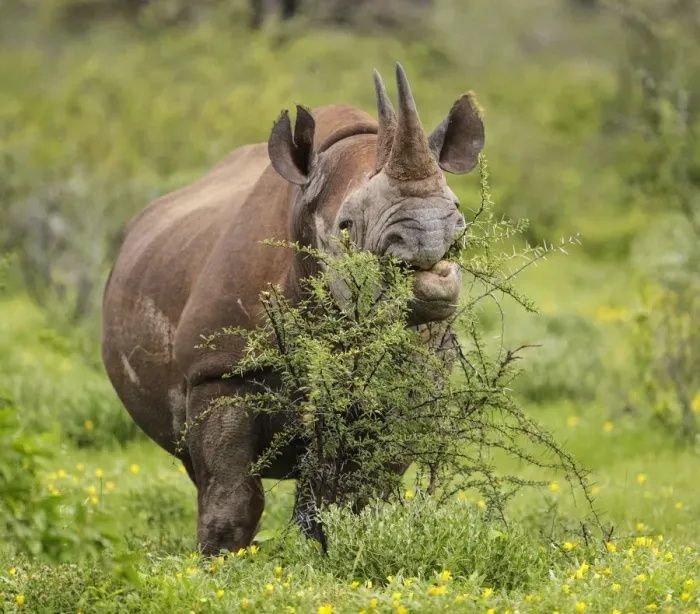
The black rhinoceros is shaped for browsing. Its pointed, hooked upper lip is highly mobile and functions almost like a small grasping tool, allowing the animal to select individual leaves, twigs, and shoots from thorny shrubs. This precision matters in the Sandveld, where valuable foliage may be protected by spines or mixed among unpalatable plants. Rather than lowering its head to sweep across a uniform carpet, a black rhino can reach into woody vegetation, pull a branch toward its mouth, and strip or clip the most nutritious parts.
That feeding architecture is supported by a characteristically higher head posture and a body built for maneuvering through bush. Black rhinos are generally smaller than white rhinos, although both are formidable animals, and their browsing style requires repeated decisions at close range. Research published in Oryx examines how black rhinos select habitat and forage at several scales, from broad landscape patches to individual plants. Such work is important because fire, rainfall, vegetation change, and human management can alter the availability of the woody foods on which browsers depend.
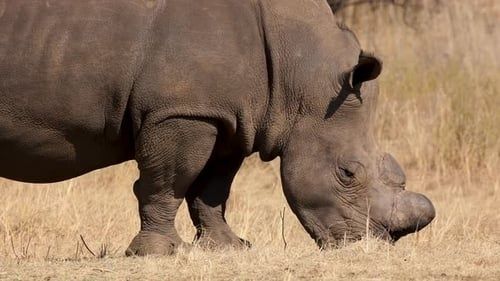
White rhinoceroses occupy a different feeding niche. Their broad, square muzzle is adapted to cropping grasses close to the ground, and the typical grazing posture places the head low as the animal moves steadily through open pasture. The wide lip gathers a larger mouthful than the black rhino”s pointed lip, making it efficient where grass is abundant enough to support bulk feeding. In and around open depressions such as Serwe Pan, this design allows white rhinos to function as powerful, deliberate lawn managers.
| Feature | Black rhinoceros | White rhinoceros |
|---|---|---|
| Cranial posture | Head commonly carried higher while browsing | Head lowered during grazing |
| Muzzle and lips | Hooked, prehensile lip for selecting leaves and twigs | Wide, square muzzle for cropping grasses |
| Dental wear pattern | Associated with processing browse, including tougher leaves and woody material | Associated with repeated cropping and grinding of grass |
| Primary forage | Shrubs, shoots, leaves, and selected woody plants | Short and medium-height grasses |
| Preferred structure | Thicker bush and browse-rich thickets | Open grassland, pans, and savanna pasture |
This distinction should not be treated as an absolute rule. Both species adjust their diets when conditions change, and local vegetation determines what is available. Nevertheless, the contrast is ecologically meaningful. When black rhinos harvest foliage above the grazing zone and white rhinos crop grass below it, the same hectare can provide food to both without being used in exactly the same way. Their differing dental demands and muzzle mechanics turn anatomy into a form of resource management.
Behavioral Tactics for Surviving Arid Pressures
Feeding differences are only part of the partitioning system. Black rhinos are generally solitary, vigilant, and more reactive to disturbance. In dense vegetation, isolation can help an individual move quietly between browse patches while reducing the need to defend a large group”s position. White rhinos, by contrast, are more commonly associated with social groups and have a calmer, more communal temperament. Several animals may graze within sight of one another, benefiting from shared vigilance while taking advantage of broad areas of pasture.
Calf positioning reflects the structure of the habitat and the mother”s method of protection. In thickets, a black rhino calf commonly follows behind its mother, where the adult body and the surrounding vegetation help conceal the young animal from danger. White rhino calves more often move in front of their mothers across open ground, where visibility is greater and the adult can monitor the calf”s position directly. These arrangements are not rigid rules, but they illustrate how social behavior and landscape structure work together.
- Black rhino mothers often use dense cover, careful movement, and close defensive reactions to protect calves.
- White rhino mothers can use open visibility and herd proximity to detect threats across grazing areas.
- Both species rely on scent, hearing, dung middens, and familiar travel routes to interpret their surroundings.
- Water access, shade, forage quality, and disturbance determine how far individuals travel during the day.
Arid pressure also shapes daily movement. During cooler periods, rhinos can travel and feed with less risk of overheating. As temperatures rise, they may seek shade, wallow, or remain near dependable water sources and productive feeding areas. White rhino groups often organize their movements around open grazing grounds and water pans, while black rhinos may travel between browse patches and sheltered thickets. Fire and rainfall can further rearrange these routes by changing the nutritional quality and density of plants. A recently burned area may produce fresh grass attractive to grazers, while the same disturbance can reduce or redistribute the woody vegetation important to browsers.
Sanctuaries Sustaining the Natural Balance
Protected areas provide more than a refuge from poaching. They preserve the spatial arrangement that allows different species to perform different ecological roles. The Khama Rhino Sanctuary is organized around Serwe Pan, a large grass-covered depression with natural water holes that provides valuable habitat for white rhinos and other grazing animals. Its southern areas contain denser vegetation, offering conditions more suitable for browsing animals and demonstrating, within one protected landscape, why habitat variety matters.
A sanctuary can maintain that variety only through active stewardship. Anti-poaching security requires trained rangers, patrol planning, intelligence gathering, communication, veterinary readiness, and reliable long-term funding. Community participation is equally important. The Trust is a community-based project, and its conservation model recognizes that wildlife protection is stronger when nearby communities have a meaningful stake in the survival of animals and the health of the land. Visitors can support this work by choosing transparent operators, following distance and noise rules, and treating conservation fees as contributions to protection rather than simply admission charges.
- Support verified sanctuary and community conservation organizations with clear governance and conservation goals.
- Choose wildlife experiences that prohibit handling, feeding, or intrusive close contact with rhinos.
- Respect ranger instructions, remain quiet, and never pressure animals to move for photographs.
- Learn whether tourism revenue supports habitat restoration, local employment, education, and anti-poaching operations.
- Recognize that protecting water, grassland, thickets, and migration routes is as important as protecting individual rhinos.
The ecological benefits extend beyond the rhinos themselves. White rhino grazing can reduce dense grass accumulation and create shorter swards used by other herbivores. Black rhino browsing can influence shrub growth and help prevent woody vegetation from becoming uniformly dense in suitable habitats. Neither species should be described as a simple replacement for fire or other land management, but their feeding activities contribute to a mosaic of vegetation heights and structures. That mosaic supports insects, birds, smaller mammals, and a wider range of herbivores, strengthening the resilience of the dryland community.
Safeguarding an Evolutionary Masterpiece
Black and white rhinos demonstrate how survival can depend on difference rather than dominance. The black rhino”s prehensile lip, elevated browsing posture, solitary alertness, and affinity for thicker vegetation complement the white rhino”s broad grazing muzzle, low head carriage, social tolerance, and use of open grassland. Their niches overlap enough to connect the ecosystem, but remain distinct enough to reduce constant competition for the same plants.
That balance is vulnerable. Habitat conversion, roads, fencing, drought intensified by climate change, disturbance around water, and the illegal trafficking of horn can undermine the conditions that allow both species to persist. Conservation therefore has to operate at ground level, through secure sanctuaries, informed ranger teams, habitat restoration, responsible tourism, and community programs that make wildlife protection durable. Supporting credible conservation organizations, visiting ethically managed reserves, and valuing intact habitat are practical ways to help preserve the Sandveld”s living architecture. The future of these two rhinoceros species depends on protecting not only the animals, but also the precise ecological relationships that make their coexistence possible.
