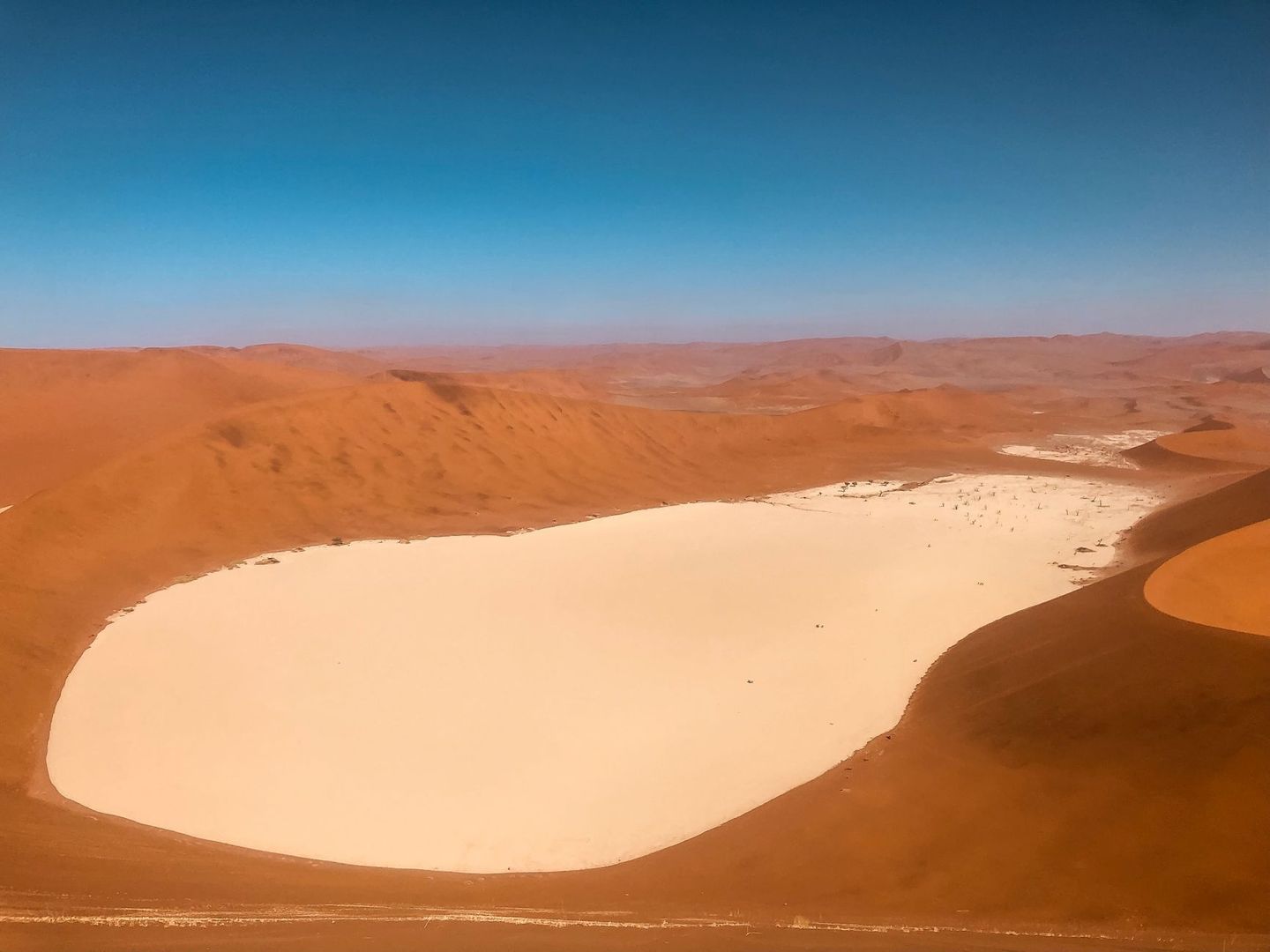
Pale clay pan surrounded by reddish desert dunes under a blue sky

The Hidden Pulse of Serwe Pan: Why Kalahari Clay Depressions Keep Wildlife Alive

Beneath the Shimmering Crust of Serwe Pan

From a distance, a Kalahari salt pan can appear to be the definition of emptiness: a pale, sun-struck surface, sparse vegetation, and no obvious sign of the animals that depend on it. Serwe Pan in central Botswana tells a more complex story. Its shallow basin is not a dead end in the landscape, but a temporary reservoir, mineral store, and meeting ground whose value becomes most visible when surrounding grasslands begin to fail. For visitors who want to understand Botswana”s rhino country, the pan offers an important lesson: wildlife survival often depends on geological features that seem lifeless at first glance.

Its ecological function begins below the shimmering crust. Impermeable calcrete, fine clay, evaporated salts, and shallow drainage pathways work together to hold storm water close to the surface. Rainfall may be brief and erratic, yet the water does not immediately disappear into the deep Kalahari sands. Minerals become concentrated as evaporation proceeds, while grasses and browse respond to short-lived pulses of moisture around the basin. This combination creates a biochemical buffer that helps zebras, springbok, rhinos, and other large herbivores endure prolonged dry spells. Serwe Pan is therefore better understood as quiet ecological infrastructure, a geological refuge that anchors regional megafauna through seasonal hardship.

The Subterranean Seal That Captures Ephemeral Rains

The Kalahari landscape has been shaped by long cycles of sediment movement, weathering, groundwater fluctuation, and changing climate. Beneath many seasonal depressions lie duricrusts, hardened layers in which minerals have accumulated and cemented sand, silt, or clay. Calcrete is especially important in semi-arid environments. It forms when calcium-rich groundwater rises or moves through sediments, then leaves calcium carbonate behind as water evaporates. Over time, repeated wetting and drying can produce a dense, resistant layer that differs sharply from the loose sands surrounding it.

Fine smectite-rich clays add another hydrological control. These clays can swell when wet and shrink as they dry, reducing the speed at which water moves downward during and immediately after storms. The process is not a simple underground tank, and Serwe Pan should not be treated as a permanently wet lake. Instead, its basin captures short-lived rainfall through a sequence of linked steps.

  1. Storm water flows from slightly higher ground toward the shallow depression.
  2. Compact clay and calcrete slow vertical infiltration, allowing water to spread across the basin.
  3. Fine sediment settles in low areas, further reducing permeability as the surface is repeatedly reworked.
  4. Evaporation gradually lowers the water level, leaving damp margins, mineral films, and isolated pools.
  5. Animals use the remaining water and the productive vegetation around the margins until the basin enters its dry phase.

This behavior contrasts with the surrounding sandveld. Dune sands are highly porous, so rainfall can vanish quickly below the root zone, particularly after intense storms. Water in a pan basin may also be lost to evaporation, but it remains biologically accessible for longer because much of it is held at or near the surface. Research on southern Kalahari pans has identified duricrusts, runoff, and seasonal water bodies as closely connected landscape processes. Studies of pan sediments also show that these depressions preserve evidence of past environmental change, making them both wildlife habitat and valuable climate archives.

Landscape surface Typical water behavior Ecological consequence
Loose sandveld dunes Rapid infiltration into deep sand Short surface-water availability and dispersed forage
Clay-rich pan floor Slow infiltration and broad shallow pooling Extended access to water and moist-margin vegetation
Calcrete-bearing basin Restricted downward drainage Retention of ephemeral water and concentration of minerals

After a substantial storm, pools may persist for weeks, depending on rainfall volume, temperature, wind, and the condition of the basin surface. The most important point is not that every pan remains wet for a fixed period, but that its hydrology stretches the useful life of rainfall. A storm that would disappear into open sand can continue to support animals through a sequence of shrinking pools, damp soils, and fresh plant growth.

Mineral Architecture and the Chemistry of Pan Soils

Water retention is only one part of Serwe Pan”s importance. As shallow water evaporates, dissolved substances become concentrated in the upper soil. Sodium and calcium are especially visible in many saline and calcareous basins, while phosphorus may be present in forms linked to sediment, organic matter, or mineral surfaces. The precise chemistry varies across the pan and changes with rainfall, groundwater movement, plant uptake, and repeated animal use. Even so, evaporation creates a strong contrast between the nutrient-poor sands of the wider Kalahari and selected parts of the basin.

This concentration matters because dry-season forage is not simply less abundant. It can also be less nutritious and less balanced. Mature grasses often contain more structural fibre and lower levels of readily available protein and minerals than young green growth. Heat, restricted water, and long-distance movement compound the problem. A recent review of climate-smart livestock nutrition in semi-arid Southern Africa describes how drought, declining feed quality, heat stress, and water scarcity interact to threaten animal condition and productivity. Wild herbivores face the same environmental pressures, even though their movement and feeding choices are not managed by people.

Soil licks can provide a targeted supplement. Herbivores may ingest small amounts of mineral-rich soil, or they may seek plants growing in unusually fertile patches. Such behavior should not be confused with ordinary grazing. It reflects a chemical need that may become particularly pressing for females carrying young, lactating animals, growing juveniles, and large-bodied species with high daily requirements. Rhinos and elephants are not visiting a pan merely for scenery or convenience. A mineral lick can be part of the physiological budget that supports reproduction, immune function, bone development, and recovery from seasonal stress.

  • Sodium supports fluid balance and nerve and muscle function, making access important during hot, dry periods.
  • Calcium contributes to skeletal maintenance, muscular activity, and the demands of pregnancy and lactation.
  • Phosphorus is central to energy metabolism, bone formation, and the development of young animals.
  • Moisture improves the quality of nearby green growth and reduces the distance animals must travel between feeding and drinking sites.

Mineral access does not make drought harmless. It is one buffer among many, and a pan cannot replace functioning regional forage, shade, migration routes, and secure water sources. Its significance lies in how these benefits overlap. A rhino can drink, feed on fresh growth, and obtain minerals within a relatively compact area, reducing exposure to heat and the energetic cost of long movements. That concentration can be especially important when the wider landscape is dry enough to turn every journey into a calculation.

How Kalahari Wildlife Navigates the Ephemeral Pulse

Wildlife use of Serwe Pan changes as the season advances. After summer rains, the first phase is a green flush. Annual plants germinate, perennial grasses produce new leaves, and insects respond to the sudden increase in plant material. This is also a period of birth and early rearing for many species. In Botswana, the green season is associated with lush scenery and frequent young animals, while the dry season typically concentrates wildlife around fewer water sources and makes predator-prey encounters easier to observe. The ecological pattern is more important than the tourism calendar: animals are following water, forage quality, temperature, and risk.

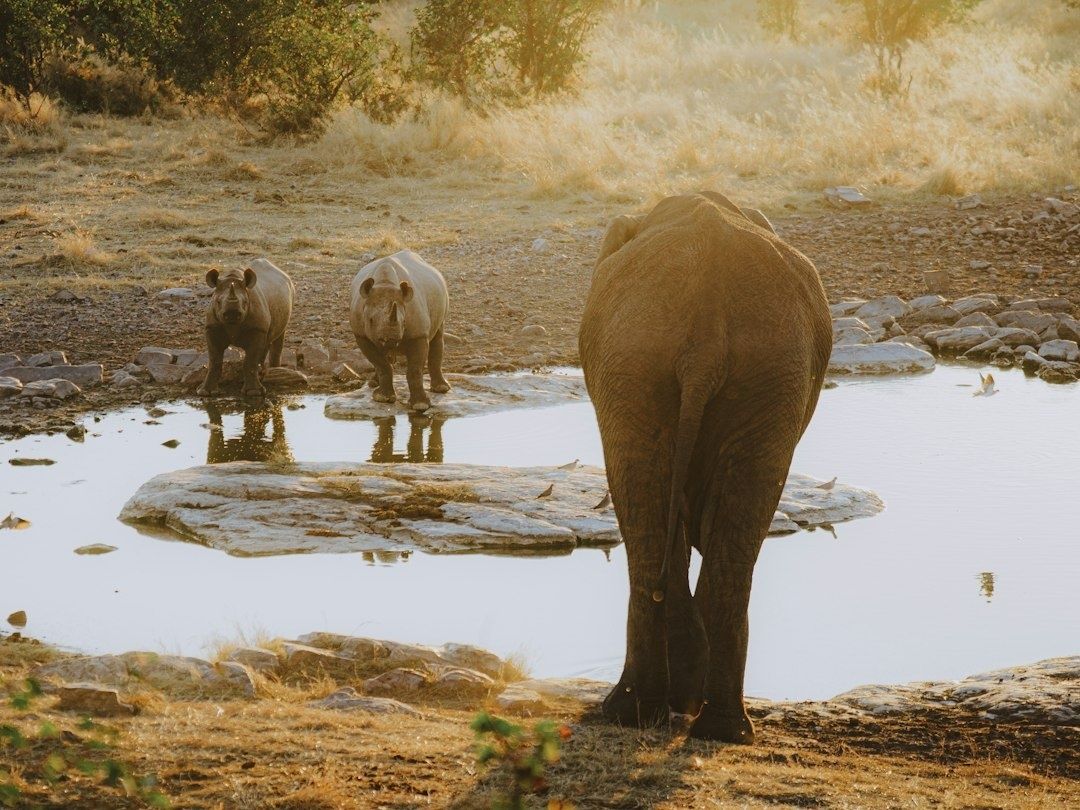
As surface water contracts, the pan becomes a rotational resource rather than a single permanent gathering point. Zebra may arrive when grass is still productive, springbok may move between open margins and nearby cover, and white rhinos may approach cautiously, using familiar routes and pauses before drinking. A field account from Khama Rhino Sanctuary described seven rhinos approaching a waterhole, with one animal moving forward while the others waited. Such spacing is consistent with the vigilance required at exposed water. Even powerful herbivores remain alert when visibility is limited and predators may be drawn to the same shrinking resource.

Elephant and two rhinoceroses gather at a shallow dry-season waterhole
As the dry season tightens its grip, shared water sources become strategic points where hydration, vigilance, and mineral access shape daily wildlife movements.
  1. Green flush brings fresh forage, breeding activity, and broad movement across the surrounding grassland.
  2. Concentration begins as smaller water sources disappear and animals use pan margins more regularly.
  3. Mineral seeking becomes more important when mature forage is fibrous and dietary deficiencies intensify.
  4. Dry-season rotation distributes pressure among remaining pools, shade patches, browse areas, and nearby depressions.
  5. Predator focus increases around dependable water, where thirst can override the caution of prey animals.

The pan”s value as a drought refuge is therefore measured not only by the animals visible at its waterhole. It also lies in the surrounding thermal landscape. Access to water reduces dehydration, while nearby green patches can reduce the need for long, exposed movements. Shade from trees or taller vegetation at the basin edge may offer relief during the hottest hours. For a large ungulate, avoiding even one unnecessary journey can conserve substantial energy during a period when food quality is already declining.

These concentrations inevitably influence predator-prey dynamics. Lions, spotted hyenas, leopards, and wild dogs may adjust their movements toward water and game trails, while prey species use vigilance, group spacing, and timing to reduce risk. A dwindling pool is not simply a place where animals gather peacefully. It is a point where thirst, nutrition, reproduction, and predation intersect. Responsible observers should remain at safe distances, keep noise low, and never pressure animals away from water, because disturbance can impose an unnecessary energetic cost during the most difficult part of the year.

Safeguarding Fragile Micro-Hydrology Against Regional Pressures

Pan systems can appear durable because their surfaces are hard and their basins have persisted for thousands of years. Their ecological function is nevertheless vulnerable to relatively small changes. Groundwater extraction may lower local water tables or alter the connection between shallow groundwater and seasonal depressions. Agricultural fencing can block traditional movement routes, separating animals from water, mineral licks, and dry-season forage. Vehicle tracks can break crusts, channel runoff, or compact soils in ways that redirect water away from the basin. Climate shifts add further uncertainty through hotter temperatures, shorter intense storms, and longer intervals between effective rainfall events.

Conservation lessons from nearby protected areas show the value of combining habitat security with active local stewardship. Khama Rhino Sanctuary, a smaller fenced reserve in southeastern Botswana, has been able to monitor its rhino population closely while maintaining a strong focus on protection. That model cannot simply be copied onto an open pan system, where seasonal movement is essential, but it demonstrates the importance of clear management, community support, reliable monitoring, and well-defined conservation goals.

  • Map pan boundaries, drainage routes, calcrete exposures, mineral licks, and wildlife approaches before approving new infrastructure.
  • Limit groundwater extraction near seasonal depressions and monitor water levels over multiple years.
  • Design fencing with wildlife movement in mind, removing obsolete barriers and maintaining safe corridors.
  • Restrict off-road driving on wet or crusted surfaces, especially after storms when tracks can become long-lasting channels.
  • Combine camera traps, rainfall gauges, vegetation surveys, and animal health observations to detect gradual change.
  • Include local communities in decisions about water, grazing, tourism, and access, because durable conservation depends on shared benefits and trust.

Tourism can support this work when it is carefully managed. Visitors should follow designated tracks, avoid crowding waterholes, and choose operators that demonstrate transparent conservation practices rather than promising close encounters. The most responsible safari experience recognizes that a pan is a living system, not a stage arranged for photographs. Protecting its crust, margins, and catchment may be more important than maximizing the number of vehicles that reach its most scenic viewpoint.

Protecting the Quiet Geological Heart of the Kalahari

Serwe Pan shows why wildlife conservation cannot focus on animal populations alone. The survival of a rhino, zebra, or springbok is tied to the physical architecture of the ground beneath it. Calcrete slows drainage, clay holds ephemeral water, evaporation concentrates minerals, and seasonal vegetation transforms a shallow depression into a refuge during the harshest months. Geology is not a passive backdrop to this process. It is an active foundation of biological resilience.

Protecting such places requires a broader definition of habitat. Conservation plans should map drainage basins, preserve recharge areas, maintain movement corridors, and treat pan surfaces as sensitive ecological infrastructure. When visitors respect waterholes and conservation managers protect the connections between soil, water, plants, and animals, Serwe Pan can continue to perform its quiet work. The lasting goal is not merely to keep wildlife visible, but to preserve the conditions that allow wild animals to survive when the rains fail and the landscape seems, from a distance, to have fallen silent.

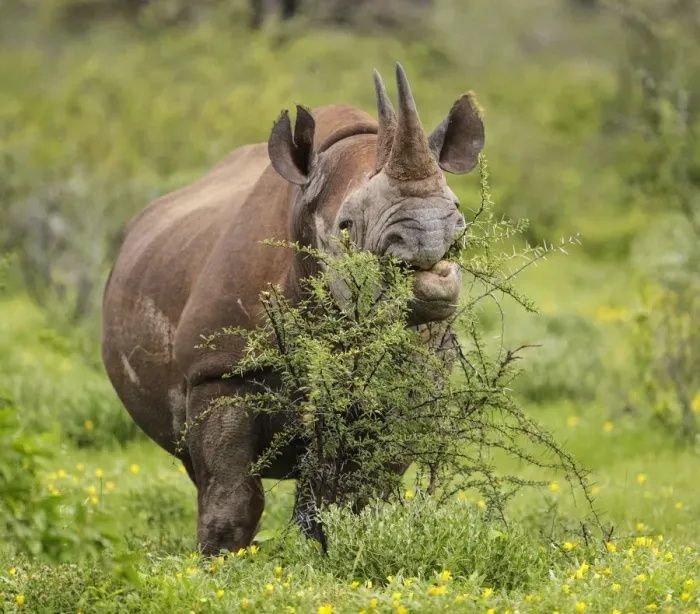
Black rhinoceros browsing a thorny shrub in green bushland

Surviving the Sandveld: How Black and White Rhinos Carve Out Niches in Botswana’s Arid Bush

Two Giants in a Thirsty Wilderness

Botswana”s Kalahari Sandveld is a landscape of restraint. Rain arrives seasonally and unevenly, grasses cure under relentless heat, shrubs compete for shallow moisture, and water pans can become the focus of nearly every large animal”s daily routine. In this dry country, survival depends less on abundance than on timing, selectivity, and the ability to use resources that neighboring species cannot exploit as efficiently. The Khama Rhino Sanctuary Trust, established near Serowe in 1992, protects an important example of this Kalahari environment, including approximately 4,300 hectares of sandveld around Serwe Pan.

At first glance, the presence of both black rhinoceroses and white rhinoceroses in the same broad region seems to pose an ecological puzzle. Each is a massive herbivore, each requires substantial food and water, and each lives under pressure from drought, habitat fragmentation, and illegal killing. Yet they can persist alongside one another because evolution has separated their ecological roles. Their differences in lip shape, head carriage, body size, social behavior, movement, and habitat preference reduce direct competition. The result is not perfect separation, but a finely balanced division of the landscape”s resources.

Architectural Feeding Adaptations of the Sandveld

The black rhinoceros is shaped for browsing. Its pointed, hooked upper lip is highly mobile and functions almost like a small grasping tool, allowing the animal to select individual leaves, twigs, and shoots from thorny shrubs. This precision matters in the Sandveld, where valuable foliage may be protected by spines or mixed among unpalatable plants. Rather than lowering its head to sweep across a uniform carpet, a black rhino can reach into woody vegetation, pull a branch toward its mouth, and strip or clip the most nutritious parts.

That feeding architecture is supported by a characteristically higher head posture and a body built for maneuvering through bush. Black rhinos are generally smaller than white rhinos, although both are formidable animals, and their browsing style requires repeated decisions at close range. Research published in Oryx examines how black rhinos select habitat and forage at several scales, from broad landscape patches to individual plants. Such work is important because fire, rainfall, vegetation change, and human management can alter the availability of the woody foods on which browsers depend.

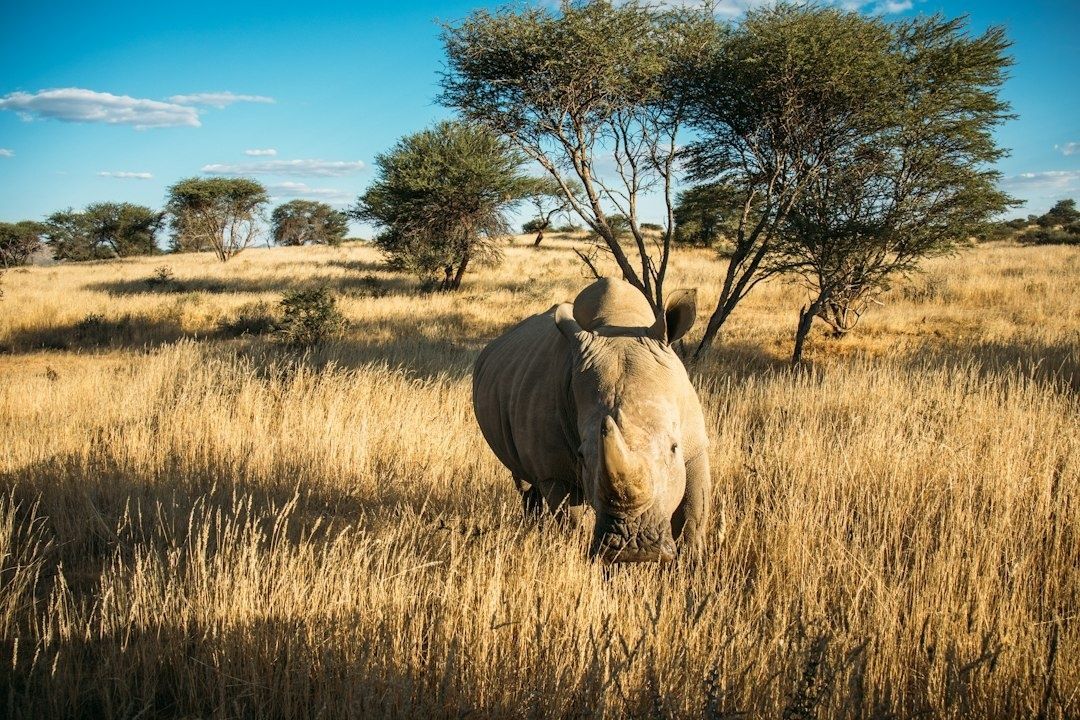
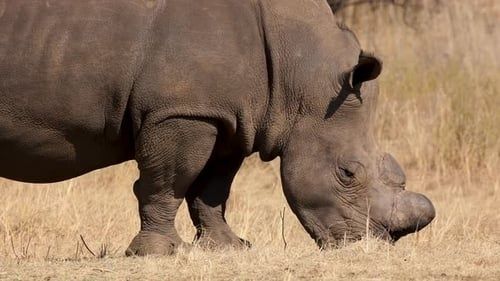
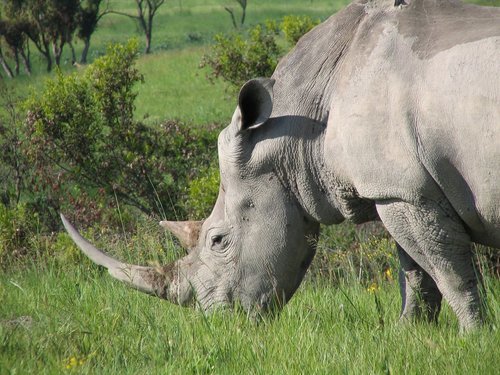
White rhinoceroses occupy a different feeding niche. Their broad, square muzzle is adapted to cropping grasses close to the ground, and the typical grazing posture places the head low as the animal moves steadily through open pasture. The wide lip gathers a larger mouthful than the black rhino”s pointed lip, making it efficient where grass is abundant enough to support bulk feeding. In and around open depressions such as Serwe Pan, this design allows white rhinos to function as powerful, deliberate lawn managers.

White rhinoceros grazing on dry grass in an arid landscape
By cropping grasses in open pasture, white rhinos help maintain a varied vegetation structure that supports other herbivores in dryland ecosystems.
Feature Black rhinoceros White rhinoceros
Cranial posture Head commonly carried higher while browsing Head lowered during grazing
Muzzle and lips Hooked, prehensile lip for selecting leaves and twigs Wide, square muzzle for cropping grasses
Dental wear pattern Associated with processing browse, including tougher leaves and woody material Associated with repeated cropping and grinding of grass
Primary forage Shrubs, shoots, leaves, and selected woody plants Short and medium-height grasses
Preferred structure Thicker bush and browse-rich thickets Open grassland, pans, and savanna pasture

This distinction should not be treated as an absolute rule. Both species adjust their diets when conditions change, and local vegetation determines what is available. Nevertheless, the contrast is ecologically meaningful. When black rhinos harvest foliage above the grazing zone and white rhinos crop grass below it, the same hectare can provide food to both without being used in exactly the same way. Their differing dental demands and muzzle mechanics turn anatomy into a form of resource management.

Behavioral Tactics for Surviving Arid Pressures

Feeding differences are only part of the partitioning system. Black rhinos are generally solitary, vigilant, and more reactive to disturbance. In dense vegetation, isolation can help an individual move quietly between browse patches while reducing the need to defend a large group”s position. White rhinos, by contrast, are more commonly associated with social groups and have a calmer, more communal temperament. Several animals may graze within sight of one another, benefiting from shared vigilance while taking advantage of broad areas of pasture.

Calf positioning reflects the structure of the habitat and the mother”s method of protection. In thickets, a black rhino calf commonly follows behind its mother, where the adult body and the surrounding vegetation help conceal the young animal from danger. White rhino calves more often move in front of their mothers across open ground, where visibility is greater and the adult can monitor the calf”s position directly. These arrangements are not rigid rules, but they illustrate how social behavior and landscape structure work together.

  • Black rhino mothers often use dense cover, careful movement, and close defensive reactions to protect calves.
  • White rhino mothers can use open visibility and herd proximity to detect threats across grazing areas.
  • Both species rely on scent, hearing, dung middens, and familiar travel routes to interpret their surroundings.
  • Water access, shade, forage quality, and disturbance determine how far individuals travel during the day.

Arid pressure also shapes daily movement. During cooler periods, rhinos can travel and feed with less risk of overheating. As temperatures rise, they may seek shade, wallow, or remain near dependable water sources and productive feeding areas. White rhino groups often organize their movements around open grazing grounds and water pans, while black rhinos may travel between browse patches and sheltered thickets. Fire and rainfall can further rearrange these routes by changing the nutritional quality and density of plants. A recently burned area may produce fresh grass attractive to grazers, while the same disturbance can reduce or redistribute the woody vegetation important to browsers.

Sanctuaries Sustaining the Natural Balance

Protected areas provide more than a refuge from poaching. They preserve the spatial arrangement that allows different species to perform different ecological roles. The Khama Rhino Sanctuary is organized around Serwe Pan, a large grass-covered depression with natural water holes that provides valuable habitat for white rhinos and other grazing animals. Its southern areas contain denser vegetation, offering conditions more suitable for browsing animals and demonstrating, within one protected landscape, why habitat variety matters.

A sanctuary can maintain that variety only through active stewardship. Anti-poaching security requires trained rangers, patrol planning, intelligence gathering, communication, veterinary readiness, and reliable long-term funding. Community participation is equally important. The Trust is a community-based project, and its conservation model recognizes that wildlife protection is stronger when nearby communities have a meaningful stake in the survival of animals and the health of the land. Visitors can support this work by choosing transparent operators, following distance and noise rules, and treating conservation fees as contributions to protection rather than simply admission charges.

  • Support verified sanctuary and community conservation organizations with clear governance and conservation goals.
  • Choose wildlife experiences that prohibit handling, feeding, or intrusive close contact with rhinos.
  • Respect ranger instructions, remain quiet, and never pressure animals to move for photographs.
  • Learn whether tourism revenue supports habitat restoration, local employment, education, and anti-poaching operations.
  • Recognize that protecting water, grassland, thickets, and migration routes is as important as protecting individual rhinos.

The ecological benefits extend beyond the rhinos themselves. White rhino grazing can reduce dense grass accumulation and create shorter swards used by other herbivores. Black rhino browsing can influence shrub growth and help prevent woody vegetation from becoming uniformly dense in suitable habitats. Neither species should be described as a simple replacement for fire or other land management, but their feeding activities contribute to a mosaic of vegetation heights and structures. That mosaic supports insects, birds, smaller mammals, and a wider range of herbivores, strengthening the resilience of the dryland community.

Safeguarding an Evolutionary Masterpiece

Black and white rhinos demonstrate how survival can depend on difference rather than dominance. The black rhino”s prehensile lip, elevated browsing posture, solitary alertness, and affinity for thicker vegetation complement the white rhino”s broad grazing muzzle, low head carriage, social tolerance, and use of open grassland. Their niches overlap enough to connect the ecosystem, but remain distinct enough to reduce constant competition for the same plants.

That balance is vulnerable. Habitat conversion, roads, fencing, drought intensified by climate change, disturbance around water, and the illegal trafficking of horn can undermine the conditions that allow both species to persist. Conservation therefore has to operate at ground level, through secure sanctuaries, informed ranger teams, habitat restoration, responsible tourism, and community programs that make wildlife protection durable. Supporting credible conservation organizations, visiting ethically managed reserves, and valuing intact habitat are practical ways to help preserve the Sandveld”s living architecture. The future of these two rhinoceros species depends on protecting not only the animals, but also the precise ecological relationships that make their coexistence possible.

From the Savannah to Your Workout

The African savannah is undoubtedly a place of unparalleled beauty, home to some of the world”s most iconic animals. From the speed and precision of a cheetah to the endurance of a zebra navigating the vast grasslands, these creatures embody qualities that inspire awe and admiration. Their patterns, movements, and natural habitats form a connection to the wild, a reminder of nature”s artistry and resilience.

A Run with Purpose

Channelling the spirit of the wild into everyday performance, the designers at Aim’n are drawing inspiration from the natural world to create functional running shorts in NZ that are also attractive. African animals represent traits that resonate deeply with runners who value strength, speed, and adaptability. Beyond aesthetics, these running shorts from NZ are crafted with high-performance fabrics designed for comfort, breathability, and durability.

Scenic Places to Run

For those inspired by the wild, Africa offers some of the most breathtaking and rugged landscapes for runners to experience. The Masai Mara in Kenya is not only a world-renowned wildlife reserve but also a stunning location for adventurous runners. Imagine jogging alongside herds of wildebeests or spotting giraffes in the distance as you run through rolling plains under vast, open skies.

Staying Cool Under the African Sun

Running in Africa”s breathtaking landscapes often comes with one undeniable challenge, and that’s the heat. With temperatures soaring, especially in regions such as the Serengeti or Masai Mara, staying comfortable and cool becomes essential for an enjoyable run. This is where the right running gear makes all the difference. Performance running shorts from NZ are designed with moisture-wicking materials that are a must-have for these conditions.

Whether you”re exploring trails under the blazing sun or jogging through humid savannah mornings, you can stay focused on your stride while fully immersing yourself in the beauty of the wild.

How Wildlife Conservation Organizations Can Improve Employee Efficiency

Improving employee efficiency at African wildlife conservation organizations, like anywhere else, may involve many things. These include implementing strategies to enhance productivity, motivation, and job satisfaction while addressing specific challenges unique to the wildlife conservation sector in Africa.

Here are five ways these employers can improve the efficiency of their staff.

Training and Skill Development

Investing in continuous training programs helps to equip employees with the necessary skills and knowledge for their roles. This includes training them on conservation techniques, data collection and analysis, project management, and communication skills, among others.

Technology Adoption

Technology is evolving faster than anyone can imagine. Hence, it is important that African wildlife conservation organizations introduce technological solutions in the workplace. For instance, the digital workplace from Omnia provides a centralized platform for communication, allowing employees to connect easily.

In today’s increasingly remote work environment, having a digital workplace is essential for enabling remote collaboration. Omnia provides tools and features that support remote work, such as video conferencing, virtual workspaces, and mobile accessibility. The solution also integrates with other tools and systems commonly used in the workplace, including emails, calendars, project management software, and CRM systems. This seamless integration enhances efficiency and ensures that employees can work more effectively from anywhere.

Incentive Programs

Incentive programs to recognize and reward high-performing employees keep them always motivated. This could be bonuses, performance-based rewards, or opportunities for career development within the industry.

Partnerships and Collaborations

Fostering partnerships and collaborations with other conservation organizations, research institutions, and government agencies helps pool resources and expertise, leading to more efficient and impactful conservation efforts.

Community Engagement

Engaging local communities in conservation efforts helps to build support for wildlife conservation initiatives. This could involve collaborating with community leaders in conducting outreach programs and involving local residents in conservation projects.

Planning for a Trip to See African Wildlife After Getting Breast Implants

Getting breast augmentation can open a world of possibilities of things you can do. It is a good way to boost self esteem, and once your self esteem is high, you can start enjoying things like travel. If going to see African wildlife has been on your bucket list and you are wondering how to do it after getting breast implants, here are tips that will make your experience better.

Get the Planning Right

The first thing you need to do is to plan everything in a way that you embark on your trip at the right time. Do research on some of the best places to tour globally, and then narrow down to how they compare with African countries where you are likely to see Africa wildlife. You should then start planning immediately on how you will schedule your implant surgery to allow you enough time to plan your trip.

Prioritize Comfort

Get your procedure done by professionals such as the ones at Motiva, and then focus on your recovery and aftercare. Prioritize your comfort. This means that when you are going for your trip to see African wildlife, you should book the right hotel that has comfortable bedding and furniture. If you have to book a flight, opt for comfortable seats, or carry your own blanket to make the travel easier.

Have a Checklist

It is always advisable to have a checklist of what you need for your travel. You will need additional things, including some medication if you are not fully recovered from getting your implants. Talk to your doctor and get a clean bill of health before you embark on your travel.

Wildlife

Styling Your Home With African Wildlife Themes

If you are a fan of African wildlife, you will be inspired by your safaris to exotic climes, and you may want to have a look at the way your home is styled. Whether you like lions, tigers, monkeys or crocodiles, then when you are not out in the wild studying and marvelling at such fantastic beasts, you need to be able to gain some inspiration from your home furnishings. People think of animal prints on the walls or models and sculptures of their favourite animals. Yet an area that is often overlooked is the use of rugs when creating your home designs. Why not check out Trendcarpet for the best in kitchen rugs and a wide selection of makes and patterns? You will no doubt give careful consideration to the furnishings of your abode. Still, a carefully chosen kitchen rug can make all the difference to your finished design.

Why Consider Trendcarpet?

This company offers a wide selection of rugs that would grace even the finest family home. In addition, when considering the exotic themes often associated with African wildlife, they offer:

  • Persian rugs
  • Sheepskin designs
  • Cowhide rugs
  • Reindeer rugs
  • Moroccan Berber styles
  • Afghan rugs
  • Wool rugs, among many others

These rugs are all designed to be non-slip, and many can even be used in an outdoor environment. Perfect to complement your range of African wildlife memorabilia, they are available in a wide range of sizes and specifications. Even if you just want to spruce up the look of a tired-looking kitchen, Trendcarpet offers the ultimate choice in classic rugs. They are provided with a free returns policy, fast delivery, and a 14-day money-back guarantee. So, you have nothing to lose when choosing the ideal accompaniment to your home. This company can also provide the following floor coverings:

  • Stair carpets
  • Living room rugs
  • Children’s rugs
  • Hallway floor coverings
  • Outdoor rugs
  • Living room rugs

Summary

Exotic carpets can evoke thoughts of faraway places where you may have been on your frequent wildlife trips to view your favourite African wildlife such as the majestic elephant, the cute zebras or the wallowing hippos. They can provide constant reminders of your favourite safaris as well as enhance the decor and functionality of your house, home or apartment. Check out Ttrendcarpet’s website today for the latest sales promotions and how to turn your place into a wildlife shrine. All at affordable cost, efficient service and a selection second to none. Whatever your tastes Trendcarpet will provide you with the perfect choice of gorgeous floor coverings and fittings.

Enjoying African Wildlife

Undoubtedly the best way to get close and personal with African wildlife is to either go on safari or visit a zoo. If finances permit, you should travel to the country of your favourite animal and view it in its natural habitat. However, with more restricted funds, then there is nothing wrong with a visit to a zoo. Remember to check whether the safari or zoo trip will feature the animal you most want to see. If you are a fan of the wild rhinoceros, then make your experience even more memorable by visiting a rhino sanctuary or a zoo where they specialise in rhinos and their study.

Setting Up a Personal Movie Room

While on your vacation or adventure, you will no doubt wish to take photos and videos to cherish your experience. As such, you should consider setting up a viewing area in your home. Here you will want to create a dedicated space where you can relax and indulge your passion for African wildlife. You can enjoy watching past experiences and jog incredible memories of past trips. You will need to give some consideration to the design and decor of your movie room, and this is where Bemz can help you with your choices.

Why Consider Bemz?

As well as offering a unique collection of cushion and seat covers for past and present Ikea furniture, they can also provide their customers with such items as:

  • Curtains
  • Cushion covers
  • Furniture legs
  • Mattress covers
  • Bedspreads
  • Fabric per metre
  • Bedskirts

Their selection of bespoke Ikea replacement covers include:

  • Armchair covers
  • Sofa covers
  • Chair covers
  • Footstool covers
  • Armrest protectors

So, if you have any Ikea furniture that you no longer have any use for or want to protect an existing piece of furniture, Bemz can provide you with the perfect choices to enhance your home movie experience. If you are inviting family and friends round to watch your latest African Rhino, or wildlife extravaganza, then elegant and stylish decor will undoubtedly improve the viewing experience.

Summary

A fascination with all types of wildlife has always been prevalent in worldwide culture and society. Many fantasise about big game in Africa and going on a safari to enjoy a first-hand experience of this fascinating subject. A dedicated home movie room is a great choice that will enable you to pursue your interest even more. You can also share your exploits when you return. To ensure your viewing room has a touch of comfort and style, why not consider Bemz products to add the perfect touch?

Using African Wildlife as a Home Décor Theme

It can undoubtedly be challenging for interior designers to come up with a good theme for their home décor. Choosing one that is too “out there” can actually make a room look garish. It is, therefore, best to go for themes that are properly tried and tested. If the designer wants the property to exude a sense of the exotic, then it is best to choose African wildlife. This will allow the home to appear like an indoor safari. It is sure to wow guests and help homeowners to express their sense of individuality. The best site to order such décor items is Royal Design because of its extensive catalogue.

Colours

One of the first things to consider when purchasing African wildlife-themed items for the home is what colour they need to be. It is wise to come up with a colour scheme and stick to it. Ordering products from Royal Design in this colour scheme will help to create a sense of consistency. For example, shades of green and brown will work well together to represent an African habitat.

Shapes

The décor does not necessarily have to contain imagery of actual animals. Instead, it could consist of items in abstract shapes that are symbolic of African wildlife. They could be in the form of furniture, upholstery, kitchenware, and much more. The broad sense of choice of this theme allows designers to get creative and think outside of the box. For example, they could utilise a candlestick holder that looks like a giraffe’s neck.

Lions

No animal is more representative of wild Africa than the lion. For years designers have utilised lions as the basis for their home themes. There are several lion-shaped items from Royal Design available to purchase. They tend to be in neutral colours such as black and white. This means they will go well with practically any colour scheme.

Monkeys

Monkeys are another prevalent form of wildlife often found on the African continent. Royal Design offers fine wooden sculpted monkey ornaments that will brighten up a room. Monkeys are perfect for people who want a less serious interior. This is because these animals tend to be amusing to guests. In contrast, lions create a sense of nobility and fierceness.

Elephants

Elephants are another perfect animal to base the theme around. Their unique but popular shape means that designers have plenty of freedom when it comes to choosing room items. For example, the elephant bottle opener from Royal Design is both minimalist and elegant.

Plant Pots

Another option is to fill the room with plants that are either from Africa or at least appear to be. The plant pots could even be in the shape of African animals. This option is perfect for people who are looking for a more full-on, dedicated African theme. In a sense, they are turning their home into an environment that mimics a jungle.

Preparing for Your Trip to Experience African Wildlife

There is nothing under the skies that can ever take away the intensity of watching African wildlife under a dazzling sunset. No words can describe the feeling that engulfs you when you see the majestic walk of a lion, so close to the tour van or feeling that rumble of a leopard as it attacks a gazelle in the Massai Mara. Some experiences cannot be put in cold print. You have to experience them for you to feel it all. If you have never visited Africa to witness their wildlife, you should definitely have it in your bucket list.

The Preparation

For you to have the ultimate experience, you must first prepare adequately. It starts with doing your research. Identify where you want to go, and then start doing research about it. Some of the popular destinations to see African wildlife include the Serengeti, Masaai Mara, Kruger Park, Etosha Park among others. You should then ensure your documents are in order. Check if you need a passport, yellow fever card, and other essential documents that will allow you to move across borders. Get as much information about unique animals you must see and where you are most likely to spot them. You should also have a checklist of what to carry with you to make your travel comfortable. Remember to pack light so that you do not get burdened by heavy bags.

When You Arrive

Carry enough local cash to take you through as most animal parks do not take cards or foreign currency. You should, however, not have a heap of money with you. Withdraw only what you need for the day. Remember that you are going for the experience. Do not be too focused on taking photos that you forget to savour every beautiful moment of watching the animals in their wild uncaged environment.

What Do African Wildlife and Houseplants Have in Common?

These are two very different subjects, yet they have a lot in common. The big difference is that many feel that looking after houseplants is much safer than tending to African wildlife. While this may be true, they both need care, and it is our responsibility as humans to do this.

Knowledge

Those who commit to the care of animals such as wildlife or plants need the knowledge to do so. The animal keepers will rely on education, experience, and resources. For those who are going to take up houseplants as a hobby, they may need different resources. Just as there is a lot to learn about animals, the same applies to houseplants. Those who want to do their best can rely on Getplanta to assist them. This is an excellent app that will guide its users through everything they need to know about taking care of this type of plant.

Plant Feeding

One of the areas of care for houseplants is how to feed them. Just as the animals need to have the proper diet, so do the plants. The app will help the plant caretakers by taking them through each step they need for their watering requirements and nutrition. There is quite a bit to learn about this. If an individual had to rely on seeking out different resources to provide them with the right knowledge, they would find it too time-consuming. It would also be difficult for them to judge if the information they receive is accurate. The information that is contained in the app can be relied on when followed.

The Schedule

Animal care requires a schedule. So do houseplants. They need to be watered and fed at certain times, and they each will require their own amount of sun. The app has a care schedule that takes all the guesswork out of what each plant needs.

What to Choose

Those who want to focus on wild animal care will usually pick a few creatures they wish to specialize in. The same applies to the individual who wants to be involved in houseplants. However, there are so many different species that it can be challenging to know which ones will be the best. Plants adapt to specific environments. The app has an extensive database that is filled with important information. This can be relied on to guide the plant keeper on which ones they may want to specialize in. It can be a money and time saver. It helps avoid the mistakes of choosing the wrong plants for the environment they will be kept in.