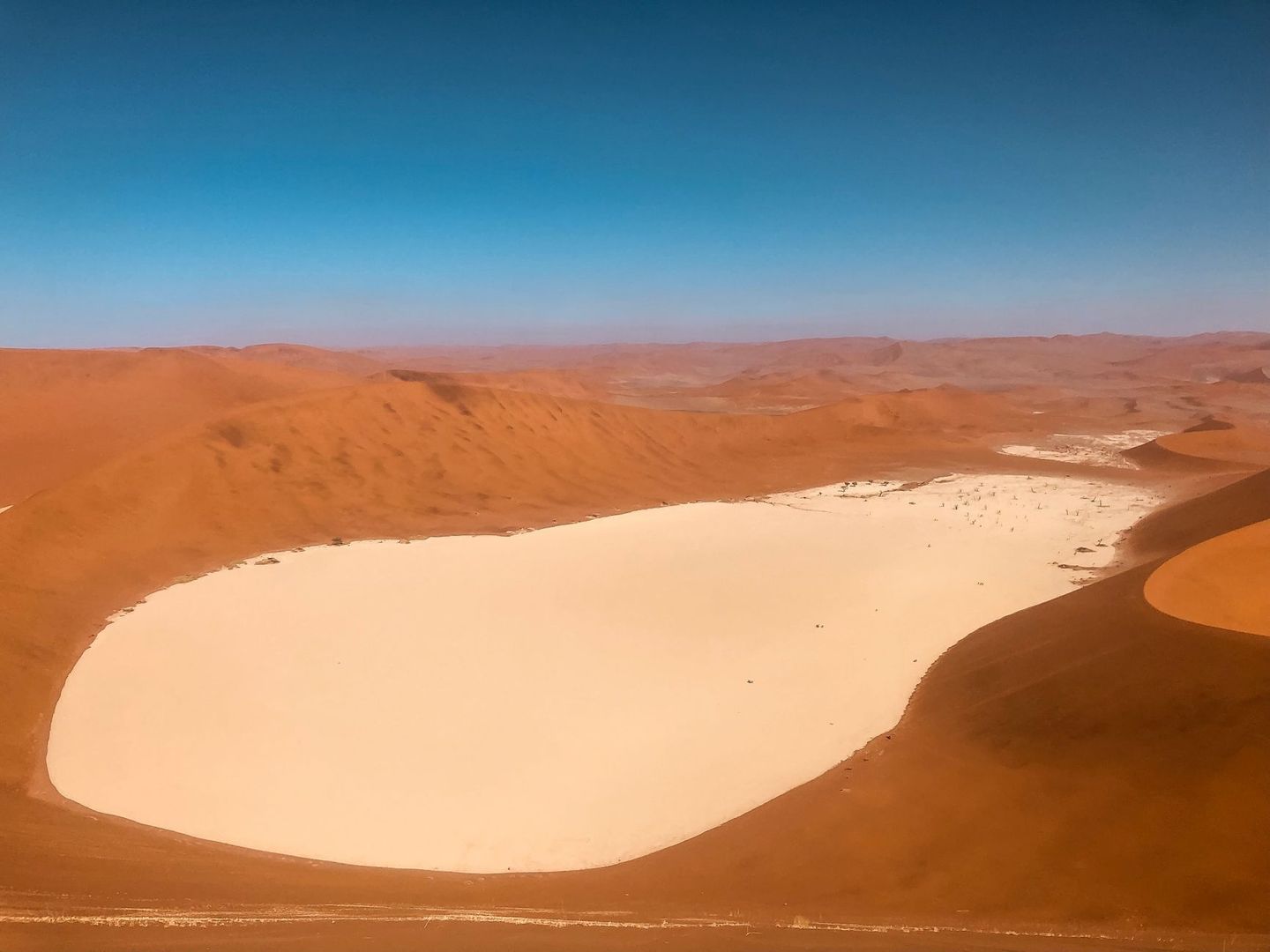
Beneath the Shimmering Crust of Serwe Pan
From a distance, a Kalahari salt pan can appear to be the definition of emptiness: a pale, sun-struck surface, sparse vegetation, and no obvious sign of the animals that depend on it. Serwe Pan in central Botswana tells a more complex story. Its shallow basin is not a dead end in the landscape, but a temporary reservoir, mineral store, and meeting ground whose value becomes most visible when surrounding grasslands begin to fail. For visitors who want to understand Botswana”s rhino country, the pan offers an important lesson: wildlife survival often depends on geological features that seem lifeless at first glance.
Its ecological function begins below the shimmering crust. Impermeable calcrete, fine clay, evaporated salts, and shallow drainage pathways work together to hold storm water close to the surface. Rainfall may be brief and erratic, yet the water does not immediately disappear into the deep Kalahari sands. Minerals become concentrated as evaporation proceeds, while grasses and browse respond to short-lived pulses of moisture around the basin. This combination creates a biochemical buffer that helps zebras, springbok, rhinos, and other large herbivores endure prolonged dry spells. Serwe Pan is therefore better understood as quiet ecological infrastructure, a geological refuge that anchors regional megafauna through seasonal hardship.
The Subterranean Seal That Captures Ephemeral Rains
The Kalahari landscape has been shaped by long cycles of sediment movement, weathering, groundwater fluctuation, and changing climate. Beneath many seasonal depressions lie duricrusts, hardened layers in which minerals have accumulated and cemented sand, silt, or clay. Calcrete is especially important in semi-arid environments. It forms when calcium-rich groundwater rises or moves through sediments, then leaves calcium carbonate behind as water evaporates. Over time, repeated wetting and drying can produce a dense, resistant layer that differs sharply from the loose sands surrounding it.
Fine smectite-rich clays add another hydrological control. These clays can swell when wet and shrink as they dry, reducing the speed at which water moves downward during and immediately after storms. The process is not a simple underground tank, and Serwe Pan should not be treated as a permanently wet lake. Instead, its basin captures short-lived rainfall through a sequence of linked steps.
- Storm water flows from slightly higher ground toward the shallow depression.
- Compact clay and calcrete slow vertical infiltration, allowing water to spread across the basin.
- Fine sediment settles in low areas, further reducing permeability as the surface is repeatedly reworked.
- Evaporation gradually lowers the water level, leaving damp margins, mineral films, and isolated pools.
- Animals use the remaining water and the productive vegetation around the margins until the basin enters its dry phase.
This behavior contrasts with the surrounding sandveld. Dune sands are highly porous, so rainfall can vanish quickly below the root zone, particularly after intense storms. Water in a pan basin may also be lost to evaporation, but it remains biologically accessible for longer because much of it is held at or near the surface. Research on southern Kalahari pans has identified duricrusts, runoff, and seasonal water bodies as closely connected landscape processes. Studies of pan sediments also show that these depressions preserve evidence of past environmental change, making them both wildlife habitat and valuable climate archives.
| Landscape surface | Typical water behavior | Ecological consequence |
|---|---|---|
| Loose sandveld dunes | Rapid infiltration into deep sand | Short surface-water availability and dispersed forage |
| Clay-rich pan floor | Slow infiltration and broad shallow pooling | Extended access to water and moist-margin vegetation |
| Calcrete-bearing basin | Restricted downward drainage | Retention of ephemeral water and concentration of minerals |
After a substantial storm, pools may persist for weeks, depending on rainfall volume, temperature, wind, and the condition of the basin surface. The most important point is not that every pan remains wet for a fixed period, but that its hydrology stretches the useful life of rainfall. A storm that would disappear into open sand can continue to support animals through a sequence of shrinking pools, damp soils, and fresh plant growth.
Mineral Architecture and the Chemistry of Pan Soils
Water retention is only one part of Serwe Pan”s importance. As shallow water evaporates, dissolved substances become concentrated in the upper soil. Sodium and calcium are especially visible in many saline and calcareous basins, while phosphorus may be present in forms linked to sediment, organic matter, or mineral surfaces. The precise chemistry varies across the pan and changes with rainfall, groundwater movement, plant uptake, and repeated animal use. Even so, evaporation creates a strong contrast between the nutrient-poor sands of the wider Kalahari and selected parts of the basin.
This concentration matters because dry-season forage is not simply less abundant. It can also be less nutritious and less balanced. Mature grasses often contain more structural fibre and lower levels of readily available protein and minerals than young green growth. Heat, restricted water, and long-distance movement compound the problem. A recent review of climate-smart livestock nutrition in semi-arid Southern Africa describes how drought, declining feed quality, heat stress, and water scarcity interact to threaten animal condition and productivity. Wild herbivores face the same environmental pressures, even though their movement and feeding choices are not managed by people.
Soil licks can provide a targeted supplement. Herbivores may ingest small amounts of mineral-rich soil, or they may seek plants growing in unusually fertile patches. Such behavior should not be confused with ordinary grazing. It reflects a chemical need that may become particularly pressing for females carrying young, lactating animals, growing juveniles, and large-bodied species with high daily requirements. Rhinos and elephants are not visiting a pan merely for scenery or convenience. A mineral lick can be part of the physiological budget that supports reproduction, immune function, bone development, and recovery from seasonal stress.
- Sodium supports fluid balance and nerve and muscle function, making access important during hot, dry periods.
- Calcium contributes to skeletal maintenance, muscular activity, and the demands of pregnancy and lactation.
- Phosphorus is central to energy metabolism, bone formation, and the development of young animals.
- Moisture improves the quality of nearby green growth and reduces the distance animals must travel between feeding and drinking sites.
Mineral access does not make drought harmless. It is one buffer among many, and a pan cannot replace functioning regional forage, shade, migration routes, and secure water sources. Its significance lies in how these benefits overlap. A rhino can drink, feed on fresh growth, and obtain minerals within a relatively compact area, reducing exposure to heat and the energetic cost of long movements. That concentration can be especially important when the wider landscape is dry enough to turn every journey into a calculation.
How Kalahari Wildlife Navigates the Ephemeral Pulse
Wildlife use of Serwe Pan changes as the season advances. After summer rains, the first phase is a green flush. Annual plants germinate, perennial grasses produce new leaves, and insects respond to the sudden increase in plant material. This is also a period of birth and early rearing for many species. In Botswana, the green season is associated with lush scenery and frequent young animals, while the dry season typically concentrates wildlife around fewer water sources and makes predator-prey encounters easier to observe. The ecological pattern is more important than the tourism calendar: animals are following water, forage quality, temperature, and risk.
As surface water contracts, the pan becomes a rotational resource rather than a single permanent gathering point. Zebra may arrive when grass is still productive, springbok may move between open margins and nearby cover, and white rhinos may approach cautiously, using familiar routes and pauses before drinking. A field account from Khama Rhino Sanctuary described seven rhinos approaching a waterhole, with one animal moving forward while the others waited. Such spacing is consistent with the vigilance required at exposed water. Even powerful herbivores remain alert when visibility is limited and predators may be drawn to the same shrinking resource.
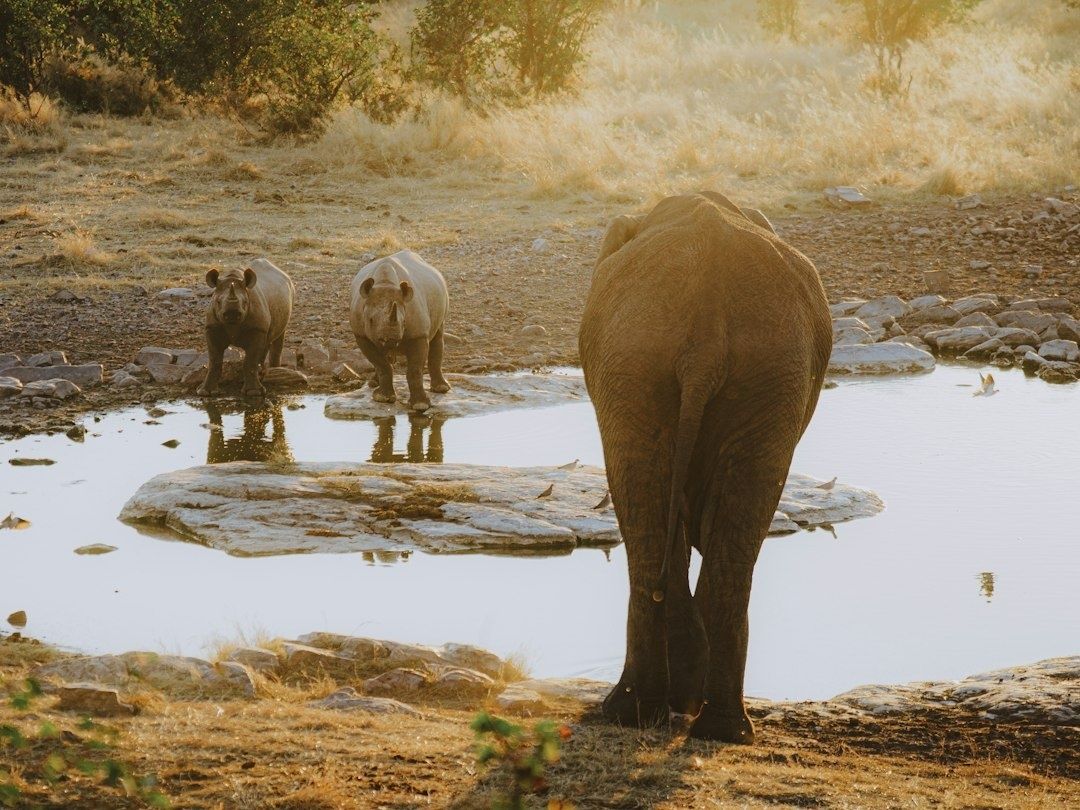
- Green flush brings fresh forage, breeding activity, and broad movement across the surrounding grassland.
- Concentration begins as smaller water sources disappear and animals use pan margins more regularly.
- Mineral seeking becomes more important when mature forage is fibrous and dietary deficiencies intensify.
- Dry-season rotation distributes pressure among remaining pools, shade patches, browse areas, and nearby depressions.
- Predator focus increases around dependable water, where thirst can override the caution of prey animals.
The pan”s value as a drought refuge is therefore measured not only by the animals visible at its waterhole. It also lies in the surrounding thermal landscape. Access to water reduces dehydration, while nearby green patches can reduce the need for long, exposed movements. Shade from trees or taller vegetation at the basin edge may offer relief during the hottest hours. For a large ungulate, avoiding even one unnecessary journey can conserve substantial energy during a period when food quality is already declining.
These concentrations inevitably influence predator-prey dynamics. Lions, spotted hyenas, leopards, and wild dogs may adjust their movements toward water and game trails, while prey species use vigilance, group spacing, and timing to reduce risk. A dwindling pool is not simply a place where animals gather peacefully. It is a point where thirst, nutrition, reproduction, and predation intersect. Responsible observers should remain at safe distances, keep noise low, and never pressure animals away from water, because disturbance can impose an unnecessary energetic cost during the most difficult part of the year.
Safeguarding Fragile Micro-Hydrology Against Regional Pressures
Pan systems can appear durable because their surfaces are hard and their basins have persisted for thousands of years. Their ecological function is nevertheless vulnerable to relatively small changes. Groundwater extraction may lower local water tables or alter the connection between shallow groundwater and seasonal depressions. Agricultural fencing can block traditional movement routes, separating animals from water, mineral licks, and dry-season forage. Vehicle tracks can break crusts, channel runoff, or compact soils in ways that redirect water away from the basin. Climate shifts add further uncertainty through hotter temperatures, shorter intense storms, and longer intervals between effective rainfall events.
Conservation lessons from nearby protected areas show the value of combining habitat security with active local stewardship. Khama Rhino Sanctuary, a smaller fenced reserve in southeastern Botswana, has been able to monitor its rhino population closely while maintaining a strong focus on protection. That model cannot simply be copied onto an open pan system, where seasonal movement is essential, but it demonstrates the importance of clear management, community support, reliable monitoring, and well-defined conservation goals.
- Map pan boundaries, drainage routes, calcrete exposures, mineral licks, and wildlife approaches before approving new infrastructure.
- Limit groundwater extraction near seasonal depressions and monitor water levels over multiple years.
- Design fencing with wildlife movement in mind, removing obsolete barriers and maintaining safe corridors.
- Restrict off-road driving on wet or crusted surfaces, especially after storms when tracks can become long-lasting channels.
- Combine camera traps, rainfall gauges, vegetation surveys, and animal health observations to detect gradual change.
- Include local communities in decisions about water, grazing, tourism, and access, because durable conservation depends on shared benefits and trust.
Tourism can support this work when it is carefully managed. Visitors should follow designated tracks, avoid crowding waterholes, and choose operators that demonstrate transparent conservation practices rather than promising close encounters. The most responsible safari experience recognizes that a pan is a living system, not a stage arranged for photographs. Protecting its crust, margins, and catchment may be more important than maximizing the number of vehicles that reach its most scenic viewpoint.
Protecting the Quiet Geological Heart of the Kalahari
Serwe Pan shows why wildlife conservation cannot focus on animal populations alone. The survival of a rhino, zebra, or springbok is tied to the physical architecture of the ground beneath it. Calcrete slows drainage, clay holds ephemeral water, evaporation concentrates minerals, and seasonal vegetation transforms a shallow depression into a refuge during the harshest months. Geology is not a passive backdrop to this process. It is an active foundation of biological resilience.
Protecting such places requires a broader definition of habitat. Conservation plans should map drainage basins, preserve recharge areas, maintain movement corridors, and treat pan surfaces as sensitive ecological infrastructure. When visitors respect waterholes and conservation managers protect the connections between soil, water, plants, and animals, Serwe Pan can continue to perform its quiet work. The lasting goal is not merely to keep wildlife visible, but to preserve the conditions that allow wild animals to survive when the rains fail and the landscape seems, from a distance, to have fallen silent.
